
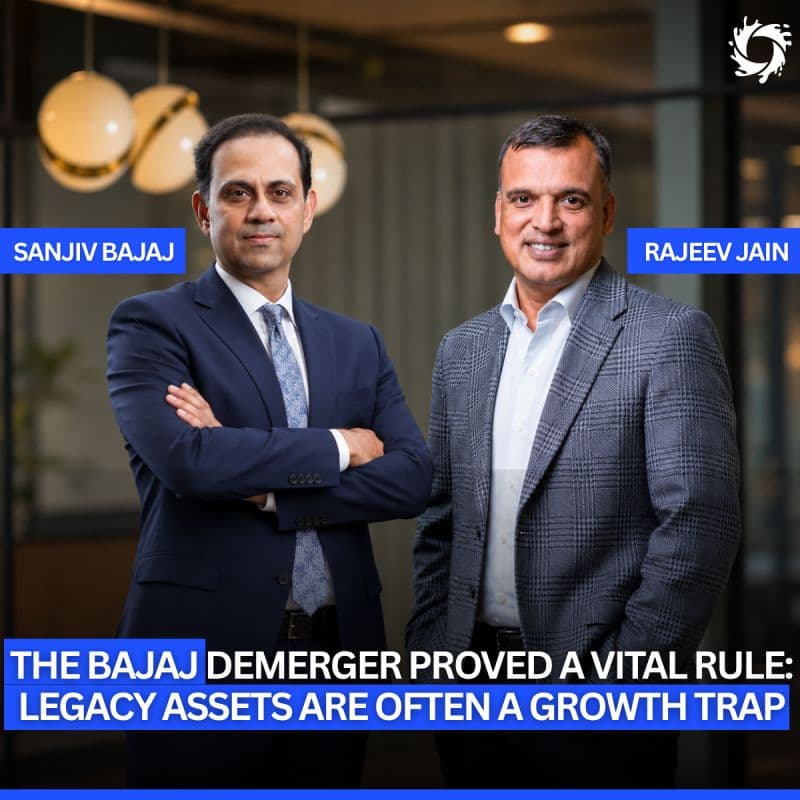
The 2007 Bajaj demerger left Sanjiv Bajaj with what appeared to be a liability: a captive financier with a ₹2,500 crore loan book, 85% locked into two-wheeler financing, and a gross NPA ratio approaching 10%. Management depth was minimal, and the business model was tethered entirely to supporting Bajaj Auto Ltd's sales.
Rather than defend this inherited perimeter, Bajaj Finance's leadership—Sanjiv Bajaj and newly hired professional CEO Rajeev Jain—made a counterintuitive move. They abandoned vehicle financing to chase a market India's traditional banks had dismissed: point-of-sale consumer durable loans, particularly no-cost EMI products.
That single bet rewired the company's trajectory. Banks had deemed the segment too fragmented, too high-volume, and too expensive to service profitably. Bajaj Finance saw the opposite: structural whitespace.
-800x450.jpg&w=3840&q=75)
-800x450.jpg&w=3840&q=75)
-800x450.jpg&w=3840&q=75)
-800x450.jpg&w=3840&q=75)
-800x450.jpg&w=3840&q=75)
-800x450.jpg&w=3840&q=75)
-800x450.jpg&w=3840&q=75)
-800x450.jpg&w=3840&q=75)