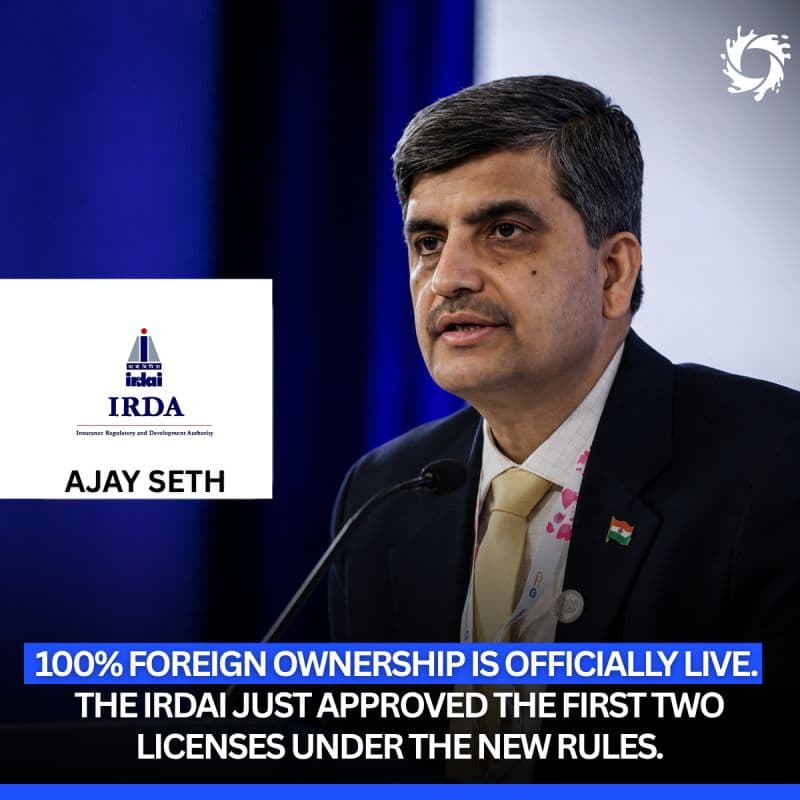
IRDAI Chairperson Ajay Seth has confirmed approval of two new general insurance licenses, marking the first major licensing wave under India's freshly liberalised foreign direct investment rules. Until now, foreign insurers entering India were forced into joint ventures with local conglomerates, capped at minority stakes and obliged to share control of brand, distribution, and proprietary underwriting technology.
The 100% FDI policy removes these constraints entirely. Global insurance giants can now establish wholly-owned Indian subsidiaries, retain full control of underwriting systems, and deploy their global balance sheets to absorb early-stage losses while scaling operations. Profit-sharing with local partners is no longer mandatory.
This structural shift fundamentally changes competitive dynamics in Indian insurance. For decades, domestic players leveraged sprawling agent networks and brand recognition built over generations. That advantage erodes when global competitors can apply sophisticated algorithms, massive capital pools, and international expertise without compromise or dilution.
-800x450.jpg&w=3840&q=75)
-800x450.jpg&w=3840&q=75)
-800x450.jpg&w=3840&q=75)
-800x450.jpg&w=3840&q=75)
-1-800x450.jpg&w=3840&q=75)
-800x450.jpg&w=3840&q=75)
-800x450.jpg&w=3840&q=75)