
Executive Summary
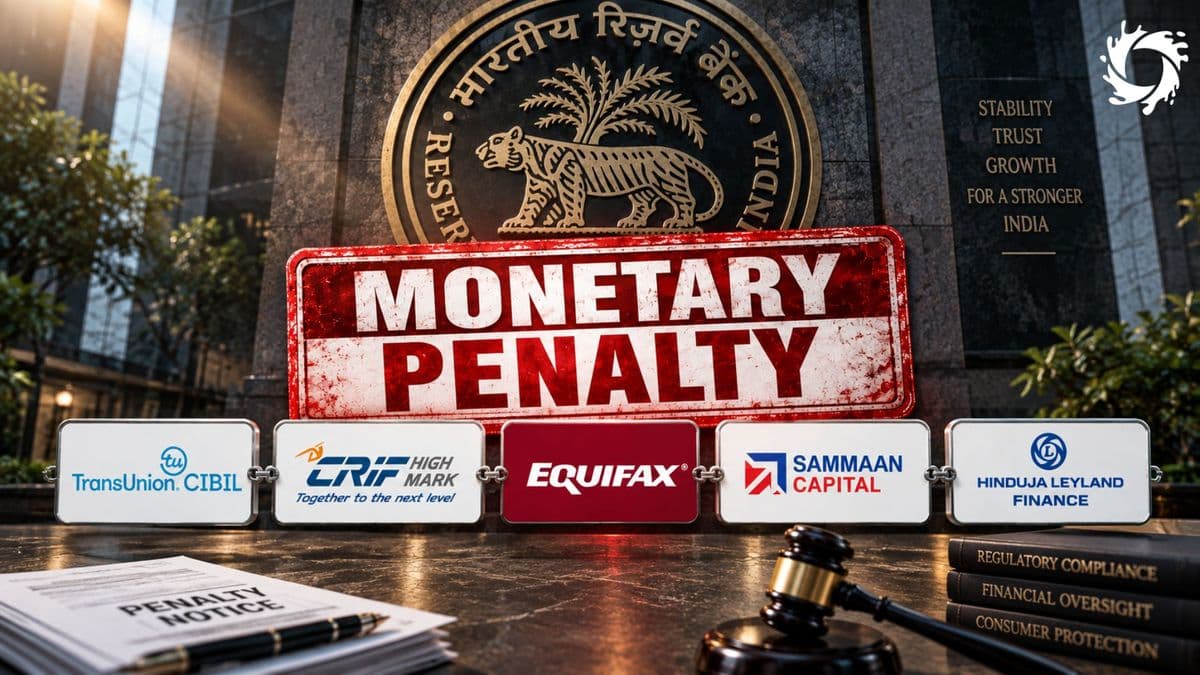
On September 04, 2026, the Reserve Bank of India (RBI) issued a coordinated volley of five supervisory enforcement orders, imposing a cumulative monetary penalty of ₹45,31,800 across three licensed Credit Information Companies (CICs)—TransUnion CIBIL, CRIF High Mark, and Equifax—and two prominent Non-Banking Financial Companies (NBFCs)—Hinduja Leyland Finance and Sammaan Finserve.
While the headline monetary figures appear minor against institutions managing tens of thousands of crores in assets and records, the regulatory intent carries seismic weight. The enforcement actions collectively strike at four structural pillars of the modern credit ecosystem:
- Consumer Credit Rectification: Enforcing actual financial restitution (the mandatory ₹100/day compensation rule) rather than cosmetic customer service ticket closures.
- Systemic Exposure Transparency: Eliminating delays in reporting large credit exposures (₹5 crore and above) to the Central Repository of Information on Large Credits (CRILC).
- Shadow De-risking: Prohibiting off-balance-sheet balance-sheet engineering via unpermitted Synthetic Securitisation.
- Boardroom Accountability in Retail Lending: Mandating strict Board governance over microfinance interest rate pricing.
The Enforcement Matrix at a Glance
Regulated EntityEntity CategoryOrder DateStatutory BasisCore Regulatory Charge SustainedPenalty (₹)
TransUnion CIBIL Limited
Credit Bureau (CIC)
Aug 31, 2026
Sec 25(1)(iii) r/w Sec 23(4), CICRA 2005
Failure to credit statutory compensation to eligible complainants' bank accounts within prescribed timelines.
₹26,82,800
CRIF High Mark Credit Information Services Pvt Ltd
Credit Bureau (CIC)
Aug 31, 2026
Sec 25(1)(iii) r/w Sec 23(4), CICRA 2005
Failure to disburse delay compensation into customer bank accounts within the prescribed framework window.
₹6,89,600
Equifax Credit Information Services Pvt Ltd
Credit Bureau (CIC)
Aug 31, 2026
Sec 25(1)(iii) r/w Sec 23(4), CICRA 2005
Failure to disburse customer compensation within prescribed statutory timelines for delayed dispute rectification.
₹1,19,400
Hinduja Leyland Finance Limited
Systemically Important NBFC
Sep 02, 2026
Sec 58G(1)(b) r/w Sec 58B(5)(aa), RBI Act 1934
(1) Lack of a Board-approved policy on pricing microfinance loans. (2) Executing transactions in the nature of prohibited Synthetic Securitisation.
₹6,20,000
Sammaan Finserve Limited
Non-Banking Financial Company
Aug 31, 2026
Sec 58G(1)(b) r/w Sec 58B(5)(aa), RBI Act 1934
Failure to report borrower credit exposure data to CRILC.
₹4,20,000
All inspections were conducted with reference to the entities' financial position as on March 31, 2025.
Section 1: The Credit Bureau Reckoning – Auditing the Outward Compensation Ledger
For years, Indian retail borrowers have struggled with bureaucratic friction when rectifying erroneous entries on credit reports. Incorrectly marked days-past-due (DPD), ghost defaults, and misattributed PAN details routinely lock retail borrowers out of home loans, MSME lines of credit, and favorable interest rate brackets.
To rectify this power asymmetry, the Reserve Bank introduced the ‘Framework for compensation to customers for delayed updation/rectification of credit information’. Under this statutory architecture:
- Credit institutions (banks/NBFCs) and credit bureaus (CICs) are granted an absolute maximum window of 30 calendar days to resolve and rectify a customer dispute.
- If the grievance exceeds 30 calendar days, the defaulting entity must pay a statutory compensation of ₹100 per calendar day directly into the complainant's bank account.
-800x450.jpg&w=3840&q=75)
-800x450.jpg&w=3840&q=75)
-800x450.jpg&w=3840&q=75)
-800x450.jpg&w=3840&q=75)
-1-800x450.jpg&w=3840&q=75)
-800x450.jpg&w=3840&q=75)
-800x450.jpg&w=3840&q=75)
-800x450.jpg&w=3840&q=75)