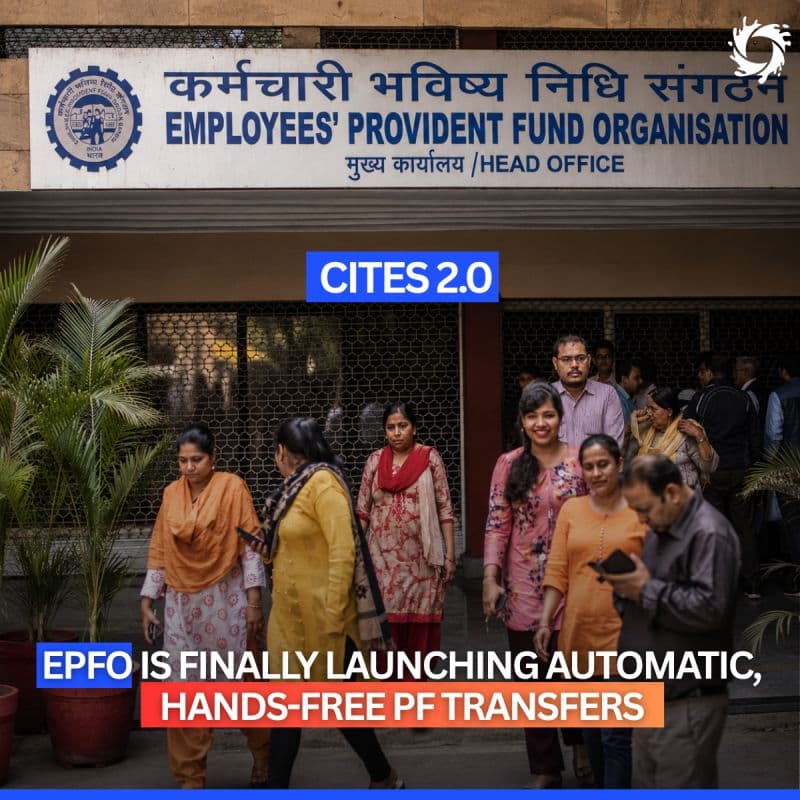
For decades, Indian workers changing jobs faced a manual nightmare: transferring their Provident Fund across regional EPFO offices. The Employees Provident Fund Organisation operated on decentralized regional databases that required slow, error-prone coordination between offices when employees moved states.
On July 25, the EPFO's Central Board of Trustees will meet to ratify CITES 2.0, a complete centralization of its IT architecture managing over 34 crore accounts. The redesign replaces legacy systems with a single, unified national database—similar to the digital public infrastructure approach that powered UPI.
Under CITES 2.0, job changes will trigger automatic, hands-free account transfers via Aadhaar-linked UAN. Workers no longer need to manually coordinate transfers between their old and new regional offices. The system eliminates the friction points that historically caused rejections and delays.
-800x450.jpg&w=3840&q=75)
-800x450.jpg&w=3840&q=75)
-800x450.jpg&w=3840&q=75)
-800x450.jpg&w=3840&q=75)
-1-800x450.jpg&w=3840&q=75)
-800x450.jpg&w=3840&q=75)
-800x450.jpg&w=3840&q=75)