
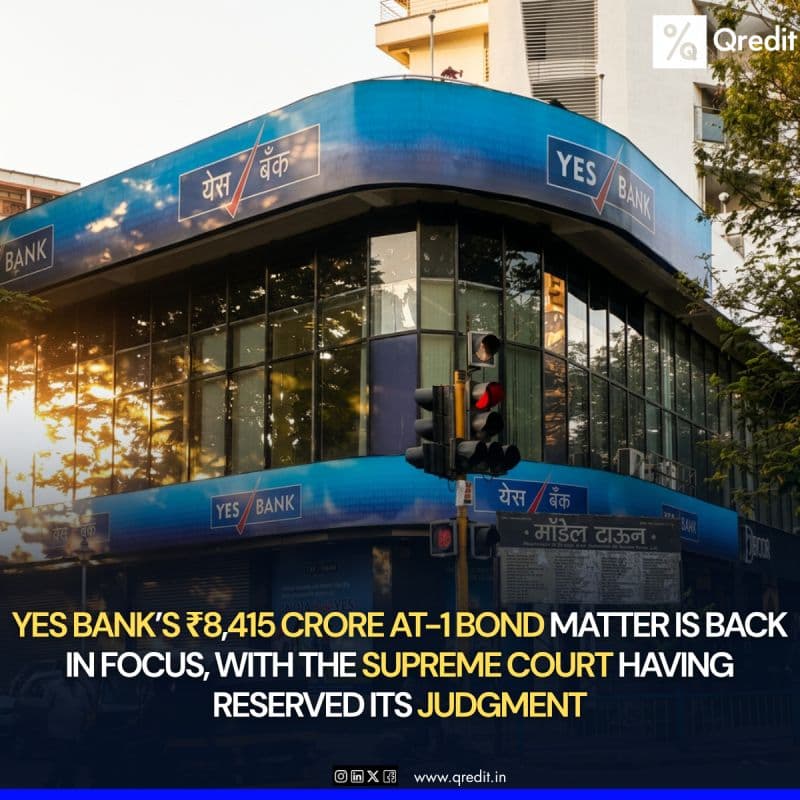
Yes Bank has stated it does not expect material financial impact from the Supreme Court's pending judgment in the AT-1 bond write-down case. The bank's position rests on its assertion that the 2020 write-down was carried out in line with applicable terms and regulations.
The dispute traces to Yes Bank's 2020 reconstruction, when approximately ₹8,415 crore worth of Additional Tier-1 bonds were written down to zero as part of the rescue process. This was a critical step in stabilizing the bank after its earlier crisis.
Bondholders challenged the write-down, and in January 2023 the Bombay High Court set aside the decision, observing that the administrator lacked authority to take that step under the final reconstruction scheme. The ruling created significant uncertainty for the bank and regulators.
-800x450.jpg&w=3840&q=75)
-800x450.jpg&w=3840&q=75)
-800x450.jpg&w=3840&q=75)
-800x450.jpg&w=3840&q=75)
-800x450.jpg&w=3840&q=75)
-800x450.jpg&w=3840&q=75)
-800x450.jpg&w=3840&q=75)
-800x450.jpg&w=3840&q=75)